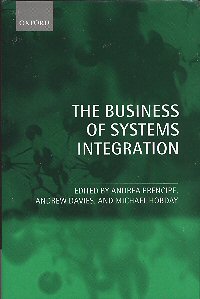
 Andrea Prencipe, Andrew Davis and Michael Hobday (Editors)
Oxford University Press, 2003
Andrea Prencipe, Andrew Davis and Michael Hobday (Editors)
Oxford University Press, 2003
ISBN 0-19-926322-1 (boards)
Buy it from Amazon.com
Buy it from Amazon.co.uk
Systems integration means, obviously enough, putting together components from different places to form a single correctly-functioning system. This in turn means that the task straddles engineering design (of whole systems, as well as of components and their interfaces) and business organization and management. Indeed, as components become commodities, or as suppliers become specialists in component design and manufacture, it becomes uneconomic for systems integrators to make such components in-house. The result is that both design and manufacture become distributed across supply chains. Engineering meets economics, and often politics as well.
The book has three parts, covering respectively the history, the theory, and the economics of systems integration, with a handful of chapters on each topic.
Systems engineers hoping for detailed guidance (like that in Stevens et al.'s Systems Engineering) on approaches, standards and techniques for system integration will be disappointed: there is none of that here. All the authors are business-oriented academics, and accordingly what the book serves up is a set of closely-argued, well-informed theoretical and historical essays from the perspectives of business schools, policy research institutes, and economics and management departments. To a systems engineer, it is striking that the most familiar of the many references are to systems theorists like Herbert Simon, and to philosophers of science and knowledge like Nagel, Quine, and Polanyi. Technologies are mentioned only as examples; even the simplest of technical concepts like interfaces and configuration are introduced in quotation marks!
Serious practical issues of complex systems development are not mentioned at all: the challenge of building what people need (rather than white elephants) is not the book's concern - nothing is said, for instance, of stakeholders, requirements, concepts of operation or even of specification. The word 'design' has to serve as a cover-all for everything down at that level, though a historical chapter does discuss the role of second world war Operational Research - where systems thinking originated - in helping to improve weapon effectiveness.
There is no denying that the complex systems of the 20th Century, those whose development needs spurred the creation of systems engineering, were weapons. The historical chapters begin with a fascinatingly readable account, 'Inventing Systems Integration', by Harvey Sapolsky of MIT, in which the roles of the DoD, hot and cold wars, and colourful figures like Secretary of Defense Robert McNamara of the 1960s are convincingly brought out. Stephen Johnson's chapter on the social solution of technical problems continues with the grimly intriguing tale of ballistic missile development. Test results often couldn't be relied upon because the actual hardware configuration of test missiles didn't match their supposed specifications: one can see that that might make debugging difficult. "It would be much better to prevent the problems in the first place." (p41). This is, of course, the crux of systems engineering / systems integration: by the time you have got into a tangle with components that don't fit, it's too late. How Johnson manages to discuss the implications of this, elegantly, without mentioning specifications or traceability is a minor miracle.
The theoretical chapters talk as usual about lofty abstractions like organisational memory and how markets learn. Massimo Paoli of the University of Perugia tops these by launching into flights of fancy such as the 'redundancy of intelligence paradigm' and 'the concept of the autopoietic system'.
Rather more practically, Mari Sako of the Saïd Business School at Oxford, and then Akira Takeishi and Takahiro Fujimoto (of Hitotsubashi and Tokyo universities, Tokyo) examine the relationships of (hierarchical) product architecture and organizational architectures in the automotive industry in their Part III chapters. The key questions are plainly how do you share out the work of design and manufacture so that you can create and integrate winning products quickly and cheaply: all the issues are interlinked. The processes the researchers looked at are still evolving rapidly, so nothing as definite as a conclusion is to be had. But the argument that there is a dynamic is hard to counter: "Changes in the hierarchies in production system and/or inter-firm system cause tension in their relationships with product architecture, and thus encourage [its] redefinition" (p273).
Systems integration is an important subject: this book shows that it is much bigger than simply 'software architecture', for instance. It has long been overlooked because it does not fit neatly into categories like 'business' or 'engineering'. This book is a welcome snapshot of what researchers know about it today, and how it came into being.
© Ian Alexander 2004